Building Without a Blueprint: Yorktown’s Infrastructure Challenge

Development and infrastructure should move like oars on a rowboat—pulling together in rhythm to move forward efficiently. But in Yorktown, we’re witnessing a concerning pattern where development outpaces infrastructure, leaving us veering off course.

As high-density housing projects advance across our town, we’re seeing a troubling disconnect between growth and the foundational services that support it. When we approve developments before confirming infrastructure capacity, we’re left with unsuitable projects—projects that may look viable on paper but can’t actually support what is promised. This isn’t just about convenience—it’s about public safety, quality of life, and responsible planning.

Safety Services Stretched Thin

Our volunteer fire departments and ambulance corps have served Yorktown admirably for decades, but have we conducted a comprehensive assessment of how multiple high-density developments will impact their capacity? These dedicated volunteers already respond to emergencies across our growing community. Adding hundreds of new residents without ensuring adequate emergency response capabilities puts everyone at risk.

Volunteer services work when call volumes are predictable and manageable. But rapid residential growth without corresponding infrastructure investment, including capacity, equipment, and training, creates dangerous gaps in our safety net.

Transportation: The Cart Before the Horse

The Underhill Farms development exemplifies this backwards approach. Dense housing construction is proceeding before the road improvements needed to handle increased traffic are in place. Residents in these new units will be moving in while the work necessary to address traffic concerns has yet to be started, with changes still being discussed.

This creates immediate problems for new residents and existing neighbors alike—longer commutes, safety concerns, and frustrated drivers navigating inadequate roadways.

The Sewer Mirage

Perhaps most concerning is the Navajo Fields situation, where promises of sewer infrastructure are being used to justify development before the necessary approvals are obtained. The Town Board is being asked to vote on adding this project to the overlay district—essentially changing zoning rules for this specific development—before the county has determined whether the promised sewers can even be built.

County sewer decisions must consider the cumulative impact across multiple municipalities, including development pressures in Somers, Cortlandt, and Peekskill. Yorktown cannot make land use decisions based on infrastructure that may never materialize.

A Pattern of Poor Planning

These examples reveal a troubling pattern: development decisions are being made before the infrastructure needed to support them is secured. It’s like installing plumbing after the walls are already up—technically possible, but unnecessarily disruptive and expensive for everyone involved.

Responsible growth requires coordination. Development and infrastructure must advance together, each enabling the other in a carefully choreographed process that protects both current residents and newcomers.

The Path Forward

Yorktown needs to establish clear infrastructure benchmarks before approving high-density projects. This means:

  • Comprehensive emergency services capacity studies before major residential approvals
  • Transportation impact assessments with required improvements completed before occupancy
  • Firm infrastructure commitments from county and state agencies before zoning changes
  • Public transparency about the true costs and timeline of supporting development

Growth isn’t inherently bad, but unplanned growth is irresponsible. Our residents deserve development that enhances our community rather than straining it.

The question before us is simple: Will we continue letting development lead while infrastructure follows breathlessly behind, or will we insist they move forward together, as true partners in building Yorktown’s future?

When Tools Become Obstacles: How Yorktown’s Development Policies Undermine Our Community

Guest Opinion by Jann Mirchandani
Note: the following guest article was printed in the Yorktown News, May 20, 2025

Tax Exemptions and Their Impact

As I outlined in my January Letter to the Editor, Yorktown’s current Business Improvement Exemption Law (485-b) grants overly broad tax breaks to commercial developers without guiding growth toward community benefits. Since then, the Town Board’s own report showed that developers have “saved” $352,304 in town taxes from just nine projects, savings that ultimately fall on residents to make up. When school taxes are included, taxpayers are covering more than $1.5 million in lost revenue from these projects alone.

Unlike neighboring communities that evaluate proposals case-by-case, Yorktown’s automatic tax breaks ignore that market forces—not tax incentives—primarily drive development decisions. Major retailers choose locations based on traffic patterns, population density, and transportation access.

A Fragmented Approach to Growth

Yorktown’s development challenges extend beyond tax policy. We implement tools like tax incentives and overlay districts inconsistently and without a unified vision. These should work together as part of a comprehensive strategy. Instead, we grant financial incentives automatically while making overlay district decisions reactively, creating an incoherent development landscape.

Overlay districts, which add regulations or incentives on top of existing zoning, should guide development toward community goals. Instead, Yorktown implements them on a case-by-case basis. Projects like the boutique hotel and Underhill Farms were added after the districts were established, with Navajo Fields potentially joining that list. This reactive approach enables projects that increase sprawl rather than containing it.

Both our tax exemption policy and overlay district implementation represent missed opportunities to strategically guide development that strengthens our community and protects our tax base.

Environmental Impacts

Our current approach also carries significant environmental consequences. The Regional Plan Association’s April 2025 report notes that “households in suburban Westchester produce twice the greenhouse gas emissions of New York City because sprawling land use patterns require residents to drive.” The report points out that Westchester has lost around 14,300 acres of forest land since 2001, with 90% lost to sprawl.

The inconsistency in our development approach is perfectly illustrated in the current discussions about removing sidewalks from the Underhill Farms project. Though not yet approved, eliminating pedestrian infrastructure undermines the very purpose of the overlay district, which was to create walkable spaces. Removing sidewalks would force residents into cars for even short trips, increasing emissions and congestion.

Preserving Yorktown’s Character

These challenges threaten what makes Yorktown special—our green spaces, woodlands, and residential neighborhoods that draw families here. Smart development can respect both fiscal needs and community values by concentrating mixed-use projects near existing infrastructure.

A Path Forward

Yorktown needs a clear plan connecting tax breaks and zoning rules. We should review exemption requests based on community benefit instead of granting them automatically and develop an overall plan for overlay districts instead of adding projects one by one. We must look beyond short-term tax gains to consider long-term infrastructure costs while encouraging development that strengthens our tax base without burdening homeowners.

The real choice isn’t between development and preservation—it’s between our current patchwork approach and thoughtful growth that strengthens Yorktown while protecting what makes our town special.

The Pocketbook Impact of 485-b Tax Exemption

FOR IMMEDIATE RELEASE

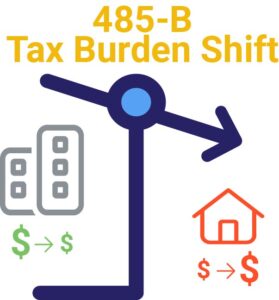
As Yorktown residents face rising costs across the board, it’s time to examine a policy that affects every taxpayer’s wallet: the 485-b tax exemption law. Enacted in 2017 and never reviewed since, this law provides substantial tax breaks to commercial developments that shift the tax burden onto residential property owners.

Town Board members point to developments like Uncle Giuseppe’s, Lowe’s, and Optum as justification for continuing these permanent tax exemptions. However, this argument overlooks a crucial fact: our neighboring municipalities attract similar commercial investments without offering such generous tax breaks. These businesses chose their locations based on market potential and community needs, not tax incentives.

The real impact of 485-b falls on Yorktown’s homeowners. While commercial properties enjoy reduced tax bills, our town’s expenses continue to rise. Basic math tells us that when some pay less, others must pay more. This “as-of-right” exemption effectively transfers the tax burden from commercial enterprises to residential property owners.

Look at our neighbors: Cortlandt has attracted major developments like ShopRite and multiple medical offices without offering blanket tax breaks. Mount Kisco continues to see new restaurants and retail establishments open their doors. Somers has welcomed new businesses in their downtown corridor. These communities prove that commercial development follows strong market conditions and community demand, not tax giveaways. Instead of automatic exemptions, our neighbors evaluate commercial incentives case by case, ensuring any tax benefits truly serve the public interest.

After six years, it’s time for a thorough review of 485-b. Do these tax breaks actually generate additional development, or are we simply subsidizing businesses that would invest here anyway? Our Town Board needs to examine this policy’s real costs and benefits, not just accept its continuation without question.

Our tax policies should benefit all Yorktown residents, not just commercial developers. The Town Board’s characterization of 485-b as merely “deferring” income rather than losing it is misleading. Under this law, commercial properties receive a 50% tax exemption in the first year, which gradually decreases over ten years. This reduced tax burden is never recovered – the town permanently foregoes that revenue. When a property’s assessment increases due to improvements, the exemption applies to that increase, meaning we lose half of the potential new revenue in year one, 45% in year two, and so on. This isn’t a deferral; it’s a decade-long subsidy that homeowners must offset.

Let’s start an honest conversation about 485-b before the next budget cycle makes the burden even heavier on homeowners’ pockets.

Jann Mirchandani
Yorktown Heights